What happened to politicians who took a view and argued for it it, rather than trying to be all things to all people?
During the budget speech I was struck immediately by Osborne's language. Early in the budget he asserted that he wanted "An economy where the state does not take almost half of all our national income, crowding out private endeavour", i.e. a much smaller public sector. But when actually announcing his plans, many of them covering the full 5-year period of this parliament,
he concentrated completely on the "its unavoidable" argument.
Of course, the two justifications imply a totally different rationale and depth of cuts. Saying "I want to reduce the size of the public sector", and "I just want to get us through this economic mess" are two very different things.
The most likely explanation is that Osborne would like to roll back the state, but the "we have to do it because we have too much debt" argument is much more palatable to voters. But failing to make the case for a smaller public sector at the out-set and focusing almost exclusively on the "necessity" of cuts doesn't avoid political arguments about the size of the state. It simply postpones them a few years to a time when people are unlikely to have much appetite for more cuts. By failing to make the argument now, Osborne has ducked his best chance to win the private sector vs. public sector debate.
It is unsurprising, then, that the Tories are trying to fight Labour on their own turf. I lost count of the number of times that Osborne claimed that the budget was "progressive", and extensive space is given in the budget document to graphs demonstrating this (though, as the IFS pointed out today, this is basically a complete lie given that the graphs stop in 2012 just before the real cuts are planned to begin). Even as a Labour-ite, I think this is a disaster. Osborne is allowing Labour to win the redistributive argument by proxy: the Tories are implicitly accepting that budgets should be a redistributive as possible. If they truly believe in the foot-steps of Thatcher and Lawson that a smaller public sector, lower business taxes and a lower top rate of income tax are the best routes to priority, that argument needs to be made now. Otherwise, it is going to be almost impossible to convince the public to move away from the distribution argument that was completely accepted on Tuesday.

Thursday, 24 June 2010

Tuesday, 22 June 2010
The Budget
The Budget has ignited debates about tax and spending. But both the Budget and the public debate ignore two enormous elephants: Pensions and Housing Benefit.
Pensions
Osborne will take some comfort from the fact that this year's borrowing requirements for the current financial year have been predicted down from the £170bn predicted by Alastair Darling in March to £143bn as predicted by the OBR. We heard that the government will begin to pay down the national debt in 2014-15.
But there is a ticking time-bomb that is simply being ignored. The State Pension already costs £63bn, and will balloon further as the number of pensioners rockets. The IEA estimate that, including pension liabilities, the national debt is over 270% of GDP - the kind of figure quoted by people like John Redwood when they claim that every man, woman and child owes something in the region of £60,000. Osborne paid lip-service to pensions, but there was little in the way of action. Moreover, his rhetoric focused only on public sector pensions and ignored the wider issue of the state pension - perhaps focusing ire at a particular group is politically easier than dealing with benefits that affect everybody?
That wouldn't be a problem if we took our current pensions arrangement at face-value. After all, current national insurance contributions are supposed to pay for current pension payments. But this ignores the nature of the state pension. We've heard plenty about how public sector pensions are unsustainable, and about how final-sector salary schemes are unsustainable. But the state pension is a scheme whereby current expenditure pays for current pensions - in other words, it is run on the basis of final-salary schemes rather than on the basis of investment schemes. The state pension in its current format is utterly unsustainable, and will mandate vast future tax increases on those of working age to pay for the failure of pensioners to get to grips with pension funding. Yet all three political parties have shown a remarkable lack of political will in failing to get to grips with it. The Budget would have been the perfect time to get all our difficult spending decisions out in the open, instead we have more procrastination and yet another spending review, yet more time wasted on recommending the bloody obvious.
Housing Benefit
Much of the public and politicians, particularly Daily Mail readers, focus on ballooning benefit bills and on "scroungers" claiming unemployment benefit. The truth is that unemployment benefit is relatively trivial, costing less than £3bn. On the other hand, Housing Benefit is over ten times bigger costing over £30bn. And as Osborne noted in the budget, HB has risen an incredible 50% above inflation over the last ten years, though he omits to mention that it's rise has been inexorable ever since the Thatcher years.
Again, Osborne paid lip-serve to the costs of HB, but only tinkered with the margins by setting an upper-limit and discussing the small minority of expensive cases. This is completely ignoring the real problem: a dire lack of affordable housing, and a Benefit system that doesn't reward tenants for negotiating the lowest possible rents. When the state is prepared to pick up the bill for housing costs at the bottom end of the spectrum fairly indiscriminantly, at the same time as making new development difficult through planning laws, then it is unsurprising that there has been massive rent inflation. This is set to continue.
The solution is very simple: build more houses. Over the medium-long term period, and given that construction costs are currently low, it is possible to recoup land and construction costs through (albeit subsidised) rents. Capital investment in housing and a real system to reward local authorities who build council houses (we were promised this in the election campaign - where is it????) are the only ways to keep Housing Benefit down, whilst simultaneously improving the quality of life for the millions currently in overcrowded housing. Indeed, the small number of outrageous HB bills that do exist only exist in the first place when local authorities cannot find any suitable housing for unusual residents. A better housing stock would simply solve this problem overnight.
So there you have it. Not an awful budget, and a good mix of different proposals. But it is not the "tough" or "brave" budget that many pretend: it fails to get to grips with the really significant long-term drivers of public spending, and instead settles for tinkering on the margins of tax. This is a temporary budget, not a budget for the future.
Pensions
Osborne will take some comfort from the fact that this year's borrowing requirements for the current financial year have been predicted down from the £170bn predicted by Alastair Darling in March to £143bn as predicted by the OBR. We heard that the government will begin to pay down the national debt in 2014-15.
But there is a ticking time-bomb that is simply being ignored. The State Pension already costs £63bn, and will balloon further as the number of pensioners rockets. The IEA estimate that, including pension liabilities, the national debt is over 270% of GDP - the kind of figure quoted by people like John Redwood when they claim that every man, woman and child owes something in the region of £60,000. Osborne paid lip-service to pensions, but there was little in the way of action. Moreover, his rhetoric focused only on public sector pensions and ignored the wider issue of the state pension - perhaps focusing ire at a particular group is politically easier than dealing with benefits that affect everybody?
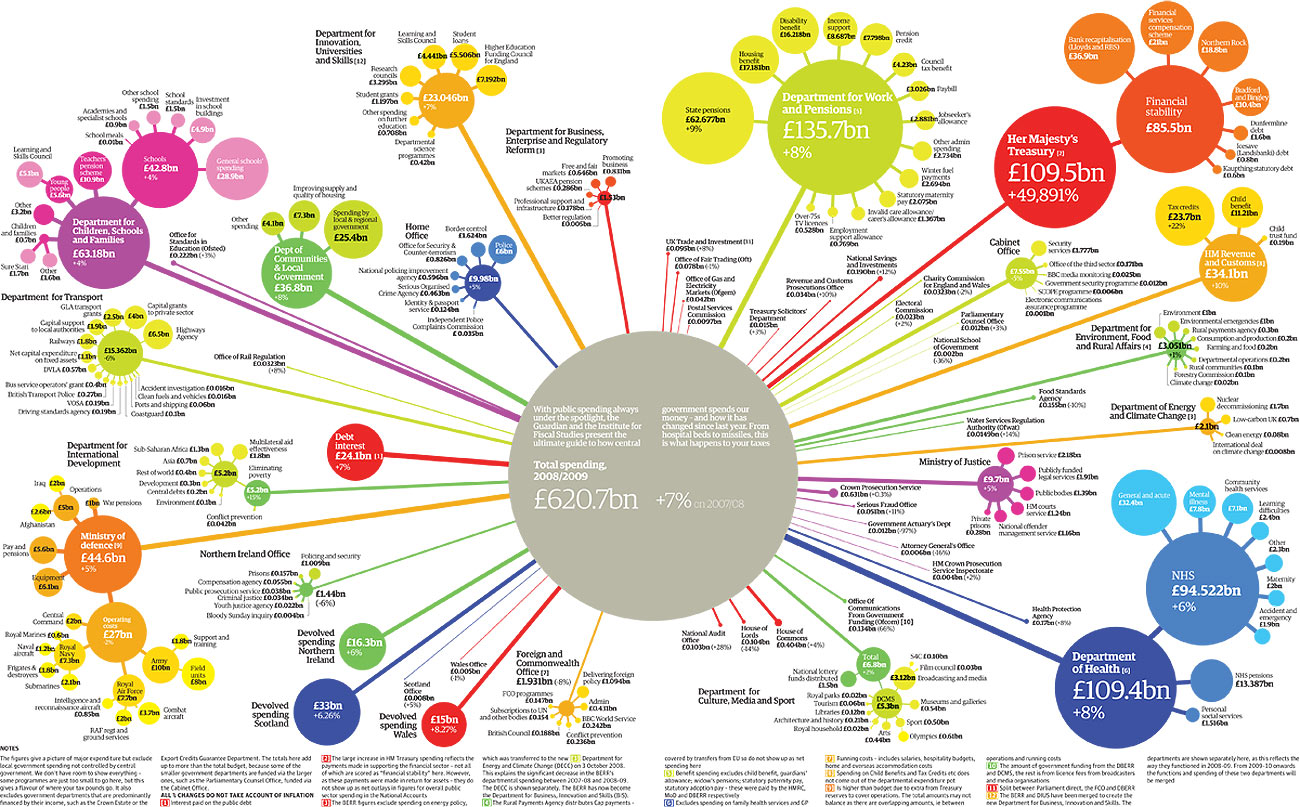
That wouldn't be a problem if we took our current pensions arrangement at face-value. After all, current national insurance contributions are supposed to pay for current pension payments. But this ignores the nature of the state pension. We've heard plenty about how public sector pensions are unsustainable, and about how final-sector salary schemes are unsustainable. But the state pension is a scheme whereby current expenditure pays for current pensions - in other words, it is run on the basis of final-salary schemes rather than on the basis of investment schemes. The state pension in its current format is utterly unsustainable, and will mandate vast future tax increases on those of working age to pay for the failure of pensioners to get to grips with pension funding. Yet all three political parties have shown a remarkable lack of political will in failing to get to grips with it. The Budget would have been the perfect time to get all our difficult spending decisions out in the open, instead we have more procrastination and yet another spending review, yet more time wasted on recommending the bloody obvious.
Housing Benefit
Much of the public and politicians, particularly Daily Mail readers, focus on ballooning benefit bills and on "scroungers" claiming unemployment benefit. The truth is that unemployment benefit is relatively trivial, costing less than £3bn. On the other hand, Housing Benefit is over ten times bigger costing over £30bn. And as Osborne noted in the budget, HB has risen an incredible 50% above inflation over the last ten years, though he omits to mention that it's rise has been inexorable ever since the Thatcher years.
Again, Osborne paid lip-serve to the costs of HB, but only tinkered with the margins by setting an upper-limit and discussing the small minority of expensive cases. This is completely ignoring the real problem: a dire lack of affordable housing, and a Benefit system that doesn't reward tenants for negotiating the lowest possible rents. When the state is prepared to pick up the bill for housing costs at the bottom end of the spectrum fairly indiscriminantly, at the same time as making new development difficult through planning laws, then it is unsurprising that there has been massive rent inflation. This is set to continue.
The solution is very simple: build more houses. Over the medium-long term period, and given that construction costs are currently low, it is possible to recoup land and construction costs through (albeit subsidised) rents. Capital investment in housing and a real system to reward local authorities who build council houses (we were promised this in the election campaign - where is it????) are the only ways to keep Housing Benefit down, whilst simultaneously improving the quality of life for the millions currently in overcrowded housing. Indeed, the small number of outrageous HB bills that do exist only exist in the first place when local authorities cannot find any suitable housing for unusual residents. A better housing stock would simply solve this problem overnight.
So there you have it. Not an awful budget, and a good mix of different proposals. But it is not the "tough" or "brave" budget that many pretend: it fails to get to grips with the really significant long-term drivers of public spending, and instead settles for tinkering on the margins of tax. This is a temporary budget, not a budget for the future.
Sunday, 13 June 2010
Banking Reform: Which way forward?
Banks are back on the agenda now that the "Future Of Banking Commission", chaired by David Davis and featuring Vince Cable has reported back. BBC report here, full report here.
Many of the proposals are pretty mundane. Stricter disclosure rules, a mandatory "opt-in" system for unauthorised overdrafts and pushing depositors up the priority list on bankruptcy all make sense. These proposals all accept free-markets and accept the fundamental desirability of individuals making their own informed choices, they simply aim to ensure that markets and competition can operate.
But what is interesting about some of the proposals is how some of them are remarkably anti-free market. In particular, the Commission wants to introduce "standard products for some basic services which all retail providers have to provide". Can one imagine the government telling Tesco that they MUST sell oranges at a state dictated price? This is truly remarkable, and makes me think of Stalinist Communism more than free-markets. Davis pays heavy lip-service to Conservative ideas with statements like "[we need to]reintroduce the rigours of effective competition and market discipline to financial services", but many of the proposals he backs are simply incompatible with any sort of ideology somewhere to the free side of Genghis Khan.
The nannying continues. The Commission appears to be concerned with "off-market" derivatives trading. Even though such trading is conducted solely by experienced professionals who fully understand the risks and are prepared to lose money, the Commission sees fit to impose registration, regulation and margin requirements. The financial crisis was caused by risk being under-priced, mis-allocated and under-estimated. In short, it happened because risk hit those who could not bear it. It is simply nonsense to try and use the crisis to regulate those who knew exactly what they were doing. In any event, institutions such as hedge funds who made investments traditionally seen as highly 'risky' seem to have done very well!
So there we have it. One of the darlings of the Conservative right has decided that markets which allow individuals to make their own choices isn't such a good idea, after all. Despite being a man of left-wing views, this report is a perfect example of how even right-wing politicians make one of the worst follies of state-hood. It sees a problem, twists the problem and regulates an inappropriate response; whilst completely ducking the real causes of the crunch.
Many of the proposals are pretty mundane. Stricter disclosure rules, a mandatory "opt-in" system for unauthorised overdrafts and pushing depositors up the priority list on bankruptcy all make sense. These proposals all accept free-markets and accept the fundamental desirability of individuals making their own informed choices, they simply aim to ensure that markets and competition can operate.
But what is interesting about some of the proposals is how some of them are remarkably anti-free market. In particular, the Commission wants to introduce "standard products for some basic services which all retail providers have to provide". Can one imagine the government telling Tesco that they MUST sell oranges at a state dictated price? This is truly remarkable, and makes me think of Stalinist Communism more than free-markets. Davis pays heavy lip-service to Conservative ideas with statements like "[we need to]reintroduce the rigours of effective competition and market discipline to financial services", but many of the proposals he backs are simply incompatible with any sort of ideology somewhere to the free side of Genghis Khan.
The nannying continues. The Commission appears to be concerned with "off-market" derivatives trading. Even though such trading is conducted solely by experienced professionals who fully understand the risks and are prepared to lose money, the Commission sees fit to impose registration, regulation and margin requirements. The financial crisis was caused by risk being under-priced, mis-allocated and under-estimated. In short, it happened because risk hit those who could not bear it. It is simply nonsense to try and use the crisis to regulate those who knew exactly what they were doing. In any event, institutions such as hedge funds who made investments traditionally seen as highly 'risky' seem to have done very well!
So there we have it. One of the darlings of the Conservative right has decided that markets which allow individuals to make their own choices isn't such a good idea, after all. Despite being a man of left-wing views, this report is a perfect example of how even right-wing politicians make one of the worst follies of state-hood. It sees a problem, twists the problem and regulates an inappropriate response; whilst completely ducking the real causes of the crunch.
Tuesday, 9 March 2010
Crime figures: dodgy statistics and dishonest politicians
Labour say that violent crime is down by 41% since 1997, and the Tories say that it is up by 44%. They can't both be right. This post looks at the reliability of the statistics used by both sides, and at how politicians manipulate them.
Broken Britain: Tory figures
Chris Grayling started this debate when he claimed that official statistics showed crime soaring under Labour, followed by a rare rebuke from the Chairman of the UK statistics authority, as the basis on which those figures were collected changed in 2002: in particular, a police discretion as to whether or not to record a reported crime was removed.
One might have expected such an obviously misleading comparison to be written off and forgotten by Tory activists as another Grayling Gaffe. Not so. Today the Telegraph, and others, unveiled new research claiming to show the "true scale of how violent crime has grown under Labour", heiled as "vindication" for Chris Grayling by Tim Montgomerie over at Conservative Home.
There are two lazy assumptions being made here. First, it is assumed that the release of these statistics justifies Grayling's comments. They do not, as Chris Grayling had no basis on which to found his claims when he made his previous comments. A misleading use of statistics is a misleading use of statistics whether or not a subsequent study agrees with the doctored result.
Second, there is a disturbing lack of discussion concerning the reliability of the 44% figure. Out of the Times, the Sun, the Mail and the Telegraph, only the Telegraph is clear about where this figure comes from. The key words are "Statiticians in the Commons Library have used a previous Home Office estimate on the effect of the change in counting rules to estimate the impact on previous figures, had those rules been in place then".
In short, these figures are based on an old estimate of the change in the accounting rules. Given that before 2002 the police had discretion as to whether or not to record a crime, it is difficult to see how that estimate could have been anything but completely speculative. It follows that data derived from that estimate is also highly speculative. It is difficult to see how this data can be the "robust statistic" Grayling claims it is.
The third lazy assumption is that these figures are to be preferred to those put forward by Labour, derived from the British Crime Survey. The figures are completely irreconcilable: Labour's claimed 41% drop in violent crime would put violent crime at 59% of 1997 levels, and the Tory's claimed 44% rise would put violent crime at 144% of 1997 levels. In other words, the BCS says there is over twice as much violent crime as Tory figures do. As with most things, the secret is to ask people who do crime statistics for a living, and it seems very clear that Crimonologists like to use the BCS.
The only possible conclusion is that Mr. Grayling is using unreliable statistics to try and justify a misleading use of statistics. In the short-term, the Tories might bolster poll ratingsfrom those who don't read into the headlines. But in the long-term, it will be public trust in politicians that pays the price.
Broken Britain: Tory figures
Chris Grayling started this debate when he claimed that official statistics showed crime soaring under Labour, followed by a rare rebuke from the Chairman of the UK statistics authority, as the basis on which those figures were collected changed in 2002: in particular, a police discretion as to whether or not to record a reported crime was removed.
One might have expected such an obviously misleading comparison to be written off and forgotten by Tory activists as another Grayling Gaffe. Not so. Today the Telegraph, and others, unveiled new research claiming to show the "true scale of how violent crime has grown under Labour", heiled as "vindication" for Chris Grayling by Tim Montgomerie over at Conservative Home.
There are two lazy assumptions being made here. First, it is assumed that the release of these statistics justifies Grayling's comments. They do not, as Chris Grayling had no basis on which to found his claims when he made his previous comments. A misleading use of statistics is a misleading use of statistics whether or not a subsequent study agrees with the doctored result.
Second, there is a disturbing lack of discussion concerning the reliability of the 44% figure. Out of the Times, the Sun, the Mail and the Telegraph, only the Telegraph is clear about where this figure comes from. The key words are "Statiticians in the Commons Library have used a previous Home Office estimate on the effect of the change in counting rules to estimate the impact on previous figures, had those rules been in place then".
In short, these figures are based on an old estimate of the change in the accounting rules. Given that before 2002 the police had discretion as to whether or not to record a crime, it is difficult to see how that estimate could have been anything but completely speculative. It follows that data derived from that estimate is also highly speculative. It is difficult to see how this data can be the "robust statistic" Grayling claims it is.
The third lazy assumption is that these figures are to be preferred to those put forward by Labour, derived from the British Crime Survey. The figures are completely irreconcilable: Labour's claimed 41% drop in violent crime would put violent crime at 59% of 1997 levels, and the Tory's claimed 44% rise would put violent crime at 144% of 1997 levels. In other words, the BCS says there is over twice as much violent crime as Tory figures do. As with most things, the secret is to ask people who do crime statistics for a living, and it seems very clear that Crimonologists like to use the BCS.
The only possible conclusion is that Mr. Grayling is using unreliable statistics to try and justify a misleading use of statistics. In the short-term, the Tories might bolster poll ratingsfrom those who don't read into the headlines. But in the long-term, it will be public trust in politicians that pays the price.
Wednesday, 3 March 2010
Analysing the Ashcroft affair: What actually happened?
There is a lot of confusion over the Ashcroft affair. Labour have not made clear precisely how Ashcroft broke his promise, and the Tories aren't replying, save as to point out that Labour and the Lib Dems take donations from non-doms. This post looks at the promises Ashcroft made and considers whether he broke them.
On 23 March 2000, in response to being previously rejected for a peerage, Michael Ashcroft signed a document making a series of undertakings:

On 23 March 2000, in response to being previously rejected for a peerage, Michael Ashcroft signed a document making a series of undertakings:

The controversy revolves around the words "I hereby give you my clear and unequivocal assurance that I have decided to take up permanent residence in the UK".
So, what does permanent residence mean? On the face of it, the meaning is ambiguous: there is no tax status of permanent residence. Indeed, Lord Ashcroft seems to think that it means long term resident. Unfortunately for Lord Ashcroft, the status of long-term resident did not exist until 2008, so it couldn't possibly be what he meant. In 2000 there were two and not three tax statuses: that of resident, and that of a non-domicile. Given that Ashcroft was already a non-dom, and that his memorandum implies positive action, it is difficult to see what he could have possibly meant other than changing his status to ordinarily resident.
Of course, there is another possible interpretation. One might argue that Ashcroft simply meant he was going to live in the U.K., and used the words permanent residence in a meaningless Freudian manner. Again, this is untenable. Ashcroft's memorandum states that "I have given my advisers instructions to make arrangements to give effect to this decision". It is difficult to see what arrangements Ashcroft's advisers would need to make except for changing his tax status.
HMRC provide a final nail in the coffin with their defintion of domicile: "under English law you are domiciled in the country in which you have made your permanent home".
In short, it seems clear that Ashcroft did not comply with promises he made to smooth his passage into the Lords. Conservative cries of "but Labour do it too!" may be factually correct, but they completely miss the point. It seems that both sides are simply talking past one another: Labour and Liberal politicians are failing to assert and explain the basis of the issues, instead plumping for lightweight rhetoric about how the Tories have not changed, and the Tories simply reply by making an entirely different point.
The debate about the proper role of non-doms is an important one, but it is a different one: the non-dom debate must not be clouded by a sterile debate about an issue of Lord Ashcroft failing to make good on his promise.
Subscribe to:
Posts (Atom)